
How much structure does a scaling business really need?
It may not be what you want to hear, but every scaling business will need structure. And usually sooner than we’d like. “Eh”, “Oh no”, “But why? It has worked well so far.” I can almost hear the reaction of people who have grown used to informal operations and love the speed and flexibility. I can also picture some excitement from those who started noticing that things are not as efficient as they used to be but are not quite sure where to start, or even whether they should. And then there are those who feel a bit uneasy, because bringing structure to a business that has almost none means work. A lot of work.
All these reactions are completely normal. Structure is often associated with something heavy. More processes, more layers, more complexity. It’s easy to assume that it will slow everything down and turn the business into something bureaucratic. And that’s where many businesses get it wrong.
Introducing structure is about reducing friction and creating clarity. You don’t need many layers for the sake of it. You need just enough to keep the business moving forward smoothly. And that’s exactly what we’ll focus on in this article: understanding what “enough structure” actually looks like, and how to start thinking about it in your own business.
Why “more structure” is the wrong goal
You may have seen this yourself or heard about companies that went from being agile to having processes, procedures, and documentation for almost everything. Have you ever wondered why?
I can tell you with certainty that this is rarely the intended outcome. There are various reasons why businesses end up over-structuring, and it’s usually a combination of a few. Often, businesses realise too late that they need structure. In that moment, the pressure to get things running efficiently again is high, and there isn’t much time to stop and think about the best way to approach it. So they start adding more processes, more documentation, more rules, all in an attempt to address bottlenecks. Sometimes, structure is used as a substitute for proper onboarding. When there isn’t enough time to train new people, we think that processes and documentation will fill the gap. But in reality, they rarely do. Similarly, when mistakes happen (and they will) the response is often the same. Instead of looking for root causes, more gets added: extra steps, more documentation, or another approval layer.

Another common pattern is over-preparing for the future. It’s tempting to build systems for “when we get big”. And while it’s sensible to build something that won’t break with the next 20–50 hires, it often leads to creating structures designed for much larger organisations. If you’re a 50-person team, do you really need the same level of structure as a 500-person business? Probably not, unless you’re expecting to get there very quickly.
Adding more structure often leads to disappointment. Things still take longer than they should. Decisions still drag on. Frictions and issues keep appearing. And the team ends up getting frustrated again and again. That’s because the assumption that more structure will fix everything is fundamentally wrong. Structure is not about volume. It’s about clarity.
What does “enough structure” actually look like
Put simply, enough structure is about having just enough clarity for the business to run smoothly, without constant friction, and in a way that supports growth. That’s really it!
When you start thinking about structure this way, you approach it differently. You stop aiming for perfection, because it’s neither realistic nor necessary. You stop trying to organise everything or prepare for every possible scenario. And you stop adding more for the sake of it. Instead, you become more selective and focus on the areas where lack of clarity is felt most in your day-to-day operations.
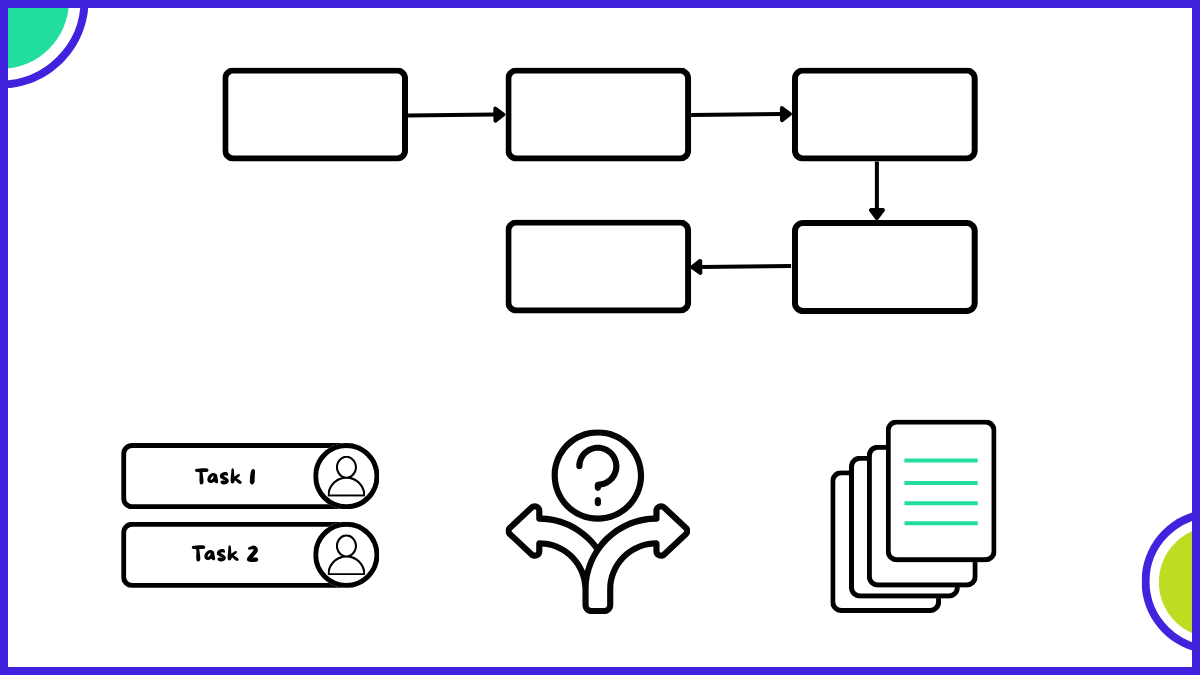
Decisions
Clarity on who decides what, and how decisions are captured.
Without it, decisions tend to be rushed and made on the go (e.g., ad hoc meetings, quick calls, or chats over coffee). As the business grows, they become harder to track, easier to forget, and more difficult to act on.
In some cases, the opposite happens - decisions slow down or stall altogether, because they all funnel through the same few people.
Ownership
Clarity on who owns what.
As teams grow, new roles get added. Some responsibilities start to overlap, while others struggle to find clear owners. The result? Tasks take longer to complete, projects get delayed, and accountability becomes blurred. Over time, this often leads to ownership being avoided and blame becoming more common when things go wrong.
Core workflows
Clarity on how repeatable work is done.
Every business has work that happens again and again. Why reinvent the wheel each time? Without a clear and repeatable way of doing it, your business is likely wasting time and dealing with inconsistent delivery and avoidable mistakes.
Information
Clarity on where information is kept and how people access it.
If key information sits in people’s heads or is scattered across different places, it becomes harder to find and harder to trust. People spend time searching, asking around, or working with incomplete information, which often leads to delays, confusion, or misalignment.
Where structure is usually not needed?
This article wouldn’t feel complete without calling out where structure usually isn’t needed, though this is likely to be different in every business, so judgement is always needed.
In most cases, structure is not needed for:
One-off tasks
If it’s done and dusted, there’s no value in structuring it.
Edge cases that rarely happen
They don’t happen often enough to justify the structure, and documenting them usually just adds unnecessary overhead.
Work that is still evolving
If it’s likely to change, any structure you put in place will need to be redone anyway.
There’s one important distinction, though.
If you start noticing the same exception being applied often, it shouldn’t be handled from scratch each time. Recurring exceptions need some level of structure.
Next steps
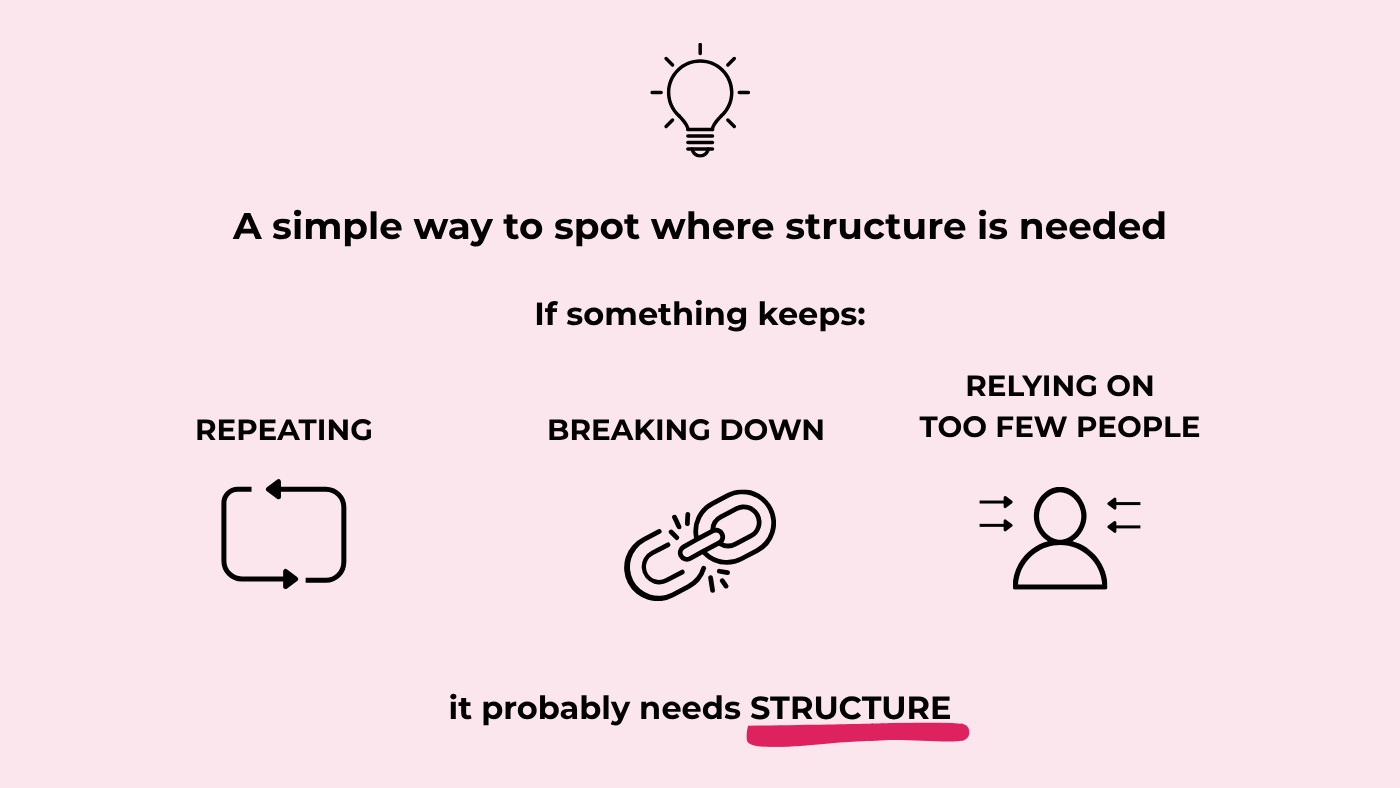
Start with the signals: Take a step back and look at your business through this lens. Where do you see work repeating, breaking down, or depending on too few people? Pick one area where this shows up most clearly.
Focus on one change: Commit to one change you can implement over the next 2–4 weeks. Even if there’s a lot to improve, take it one step at a time. Otherwise, it quickly becomes overwhelming, both for you and for the team.
Subscribe to Opsi Monthly: One email a month on building stronger operations - thoughtful, practical and designed for the realities of scaling.