
Operational Maturity: Building Operations that can support your growth
Let’s start with a little exercise.
Imagine two 40-person businesses.
Business A has documented processes, up-to-date policies, dashboards and KPIs. Teams meet weekly, responsibilities are mapped out and there’s plenty of structure around how work gets done.
Business B is much more informal. Let’s just say documentation isn’t their favourite thing to do, and they still struggle to track some of their data. But they have a strong team. People take real ownership of their work, accountability is high and decisions can be made quickly without everything travelling up to the founder.
Which business is more operationally mature?
You might be leaning towards Business A. And I can understand why. Processes, policies, data, clear structure. On the surface, it looks pretty dreamy. Or perhaps you’re leaning towards Business B. If ownership is strong, people are accountable and decisions don’t get stuck, does it really matter that everything else isn’t quite up to scratch? No business is perfect. I can see the argument for that one too.
But there’s only one answer I’d be comfortable giving you: we don’t know yet. There simply isn’t enough information.
We hear all the time that scaling businesses need more structure, more processes and policies, better tools and systems, and more formal ways of working. And there’s truth in that. A growing business can only rely on informal operations for so long. But simply accumulating more processes, systems and structure doesn’t make a business more mature.
So what does?
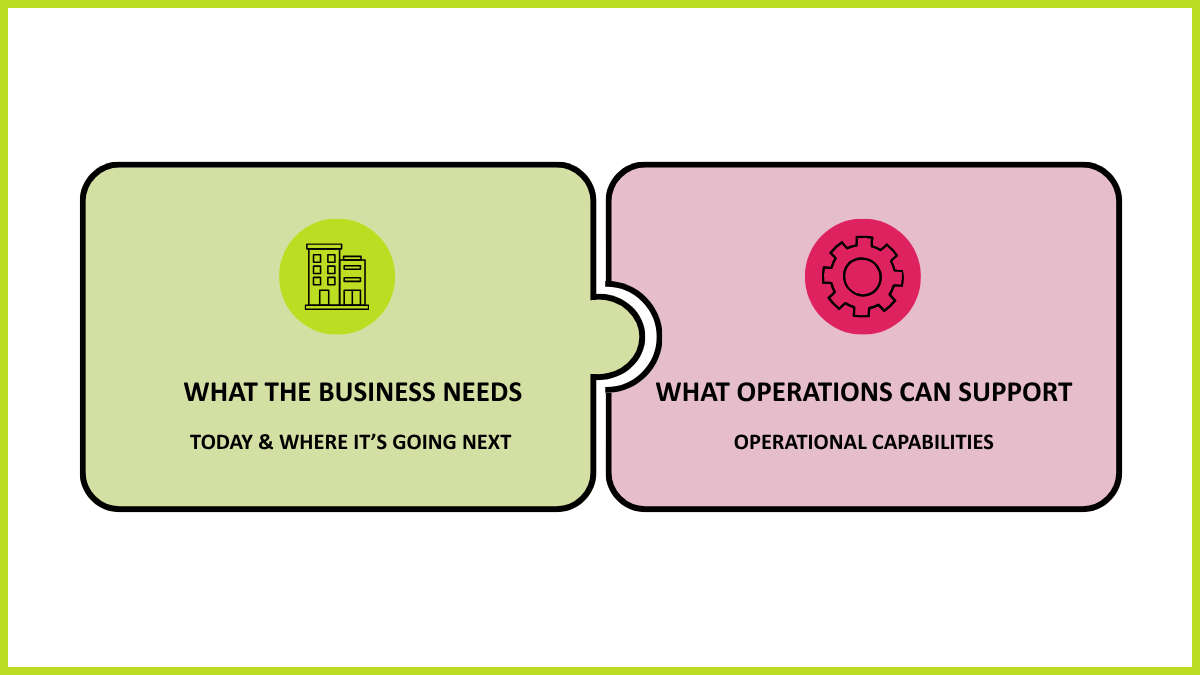
Operational maturity is about whether the way a business operates is capable of supporting the business it has become - and where it’s going next. And there’s quite a lot hiding behind that one sentence. What does operational maturity look like in practice? What parts of the business do we need to think about? And how mature do they actually need to be? Let’s unwrap it.
What’s happening beneath the surface?
In The Maturity Gap: When your business outgrows the way it operates, we looked at why strong business performance doesn’t necessarily mean Operations are keeping up. But there’s another layer to this: even when Operations look solid at first glance, it doesn’t necessarily mean that they are.
Think back to Business A. It seems to have strong operational foundations, so we could easily assume Operations are in good shape. But are they?
The processes might be followed consistently or regularly bypassed because they no longer work for the team. The dashboards might be helping people make better decisions or simply getting updated every week while nobody uses them. Policies might be properly implemented and understood or they might have been quickly put together because a client asked for them and barely looked at since.
And Business B? Strong ownership and fast decisions - what team wouldn’t want that? But is that enough?
How much time is wasted looking for information that isn’t documented anywhere? How often does repeatable work take longer than it should because there’s no standard process and the approach has to be recreated each time? How many mistakes happen because of messy handovers? And can the business really continue operating like this when another five or ten people join?
Our first impressions of either business simply don’t tell us how operationally mature they are. Hopefully, you can now see why “we don’t know yet” was the only answer I was willing to give you earlier. On the surface, Operations may look completely under control, or even just okay-ish. Underneath, things can look very different. Operational maturity asks us to look behind the scenes and dig a little deeper to understand how the business actually operates and whether that’s enough to support its current needs.
Operational maturity isn't one thing
So, we need to look beneath the surface, but where exactly do we look? We all know that businesses are complex, and so are their Operations. And as they grow, that complexity only increases. Perhaps it shouldn’t be surprising then that we won’t find operational maturity in one place. Instead, we need to look across the different operational capabilities a business needs to function well to understand its operational maturity as a whole.
For Opsi, we’ve identified eight core capabilities:
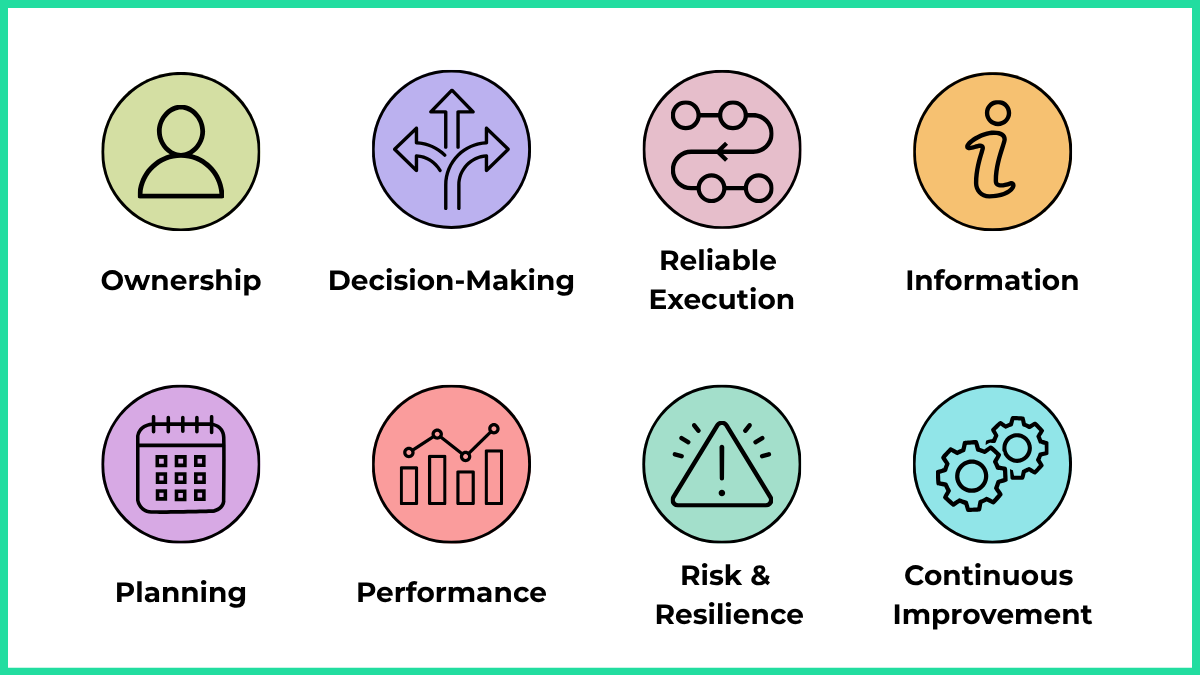
Ownership: Whether it’s clear who is responsible for what across the business, including the grey areas and work that crosses teams, and whether this translates into accountability in practice.
Decision-Making: Whether decisions can be made efficiently, with enough information and at the right levels, without decision-making becoming too centralised.
Reliable Execution: Whether work gets done consistently and to the required standard, without unnecessary problems getting in the way.
Information: Whether people can easily find and access the information they need, and trust that it’s accurate and up to date.
Planning: Whether the business is clear on what matters most and can turn its priorities into realistic plans that guide where time and resources go.
Performance: Whether the business can measure and understand its performance, and spot where attention is needed when something isn’t working.
Risk & Resilience: Whether the business understands and manages its key risks and can continue operating when things don’t go to plan.
Continuous Improvement: Whether the business can identify where things could work better and successfully make the changes that are worth investing in.
Not everything develops at the same pace
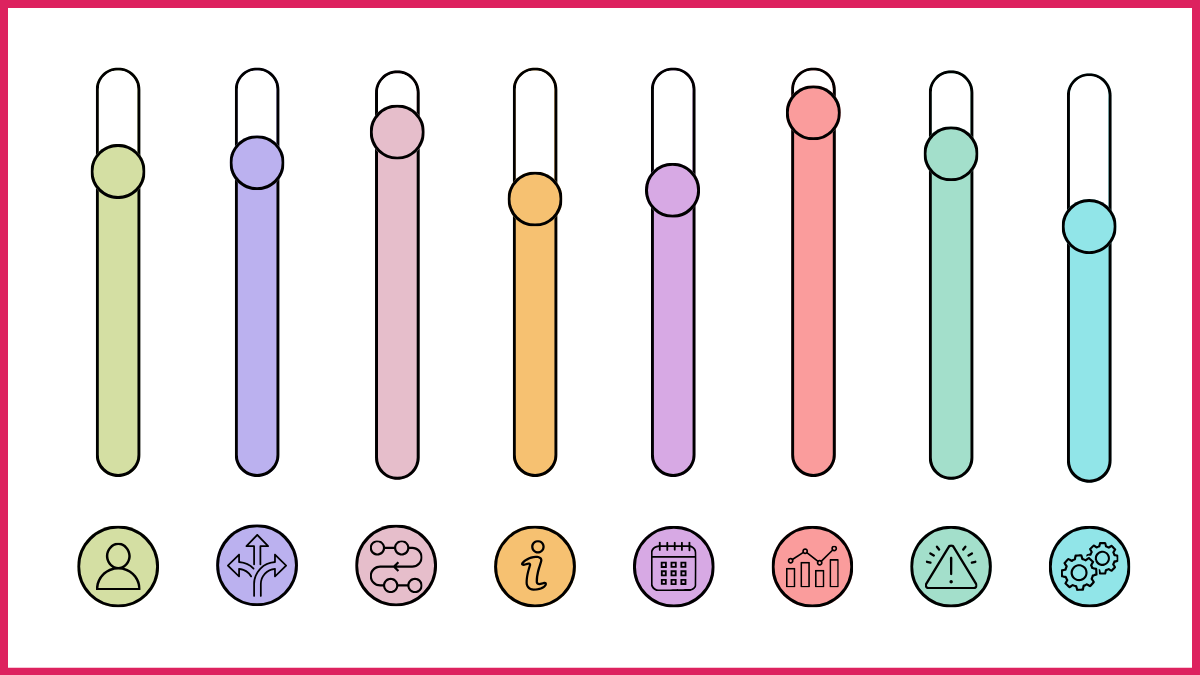
Looking at those eight capabilities may feel a little overwhelming at first. There’s quite a lot to think about, and you may already be wondering where to start and how you’re supposed to assess all of this. We’ll get there, but for now I want you to focus on building the foundations. And an important part of that is understanding that a business can be mature in one capability and much less mature in another. In fact, that’s usually what happens. Some capabilities develop faster than others. Sometimes that’s a conscious choice. Sometimes what’s happening in the business makes one capability a much bigger priority. And sometimes there isn’t much choice at all, like when you operate in a regulated industry.
There’s another important point: the capabilities may not all even need to reach the same level. How mature each one should be will depend on the business and what it needs from that capability. And yes, as Ops leaders, we have the glamorous job of figuring that out and helping the business get there.
How mature is mature enough?
And while we’re not assessing the capabilities just yet, there are two things I want you to keep in mind for when we do.
“Enough” is relative to the business: Every business is inherently different. They vary in size and complexity, how they operate, the risks they face and where they’re heading. That means each capability needs to be considered in the context of your business. What level does a business of your size and complexity really need? What makes sense for the way you operate, the risks you deal with and where the business is going next?
If you’ve read my article How much structure does a scaling business really need?, you’ll probably recognise the principle that more is almost never the answer, but the right level often is. Developing a capability beyond what the business needs can mean putting time, resources and effort into something that adds very little value. So rather than pushing every capability as far as it can go, we need to understand how far the business actually needs it to go.
“Enough” doesn’t stay still: You’ll never reach a permanent state of operational maturity because, as the business evolves, your operational capabilities should evolve with it. The job is never really done. But the good news is that you’ll be making future changes from a much more informed place. You’ll know where you are today, so those changes should be more deliberate and, hopefully, a little easier too.
There’s also the question of future-proofing your Operations. It seems reasonable: if you’re developing your operational capabilities anyway, you might as well prepare for what’s coming next. How much do we really know about what’s coming, though? Things change so quickly nowadays that I don’t see much value in preparing for a version of the business that might exist a year or two from now. But it does make sense to look ahead. I’d focus on a much shorter timeframe and the things you already have some visibility into. You don’t need 100% certainty, but if you have plans or changes on the horizon that are reasonably likely to happen over the next few months, you can start thinking about what they’ll require from your operational capabilities.
Next Steps
Take a first look at your operational capabilities: Go back through the eight capabilities and make a few quick notes on where you think your business is strong and where things feel weaker. Trust your instincts for now. You don’t need to go into too much depth, but do make a note of why you’ve reached that conclusion. Also look at what you already know is coming over the next few months and whether any of it might change what your Operations need to be capable of. Keep those notes somewhere handy; they’ll be useful when we get into a more detailed assessment of operational maturity.
There’s more to come: The eight capabilities are only one part of the Operational Maturity model we’re developing at Opsi. Next, we’ll be looking at maturity stages and what different levels of maturity look like across these capabilities. So stay tuned! And if you’d like to get the next part when it’s ready, subscribe to Opsi Monthly.